


2025 Design Patent Insights: Key U.S. Case Law Developments
This year has brought a series of significant decisions reshaping the landscape of U.S. design patent law. These rulings not only clarify key legal standards but also carry major implications for how companies protect and enforce their designs. In this month’s IP Tip, we highlight some of the most influential cases to date and share practical takeaways for patent owners and practitioners. For tailored guidance on how these developments may affect your portfolio or filing strategy, please reach out to a member of the Tucker Ellis Team.
- Claiming Priority to Utility Patent Applications: In re Floyd (Fed. Cir. April 22, 2025).
Floyd offers important lessons for filing design patent applications that claim priority to utility patent applications. In Floyd, the utility application was related to a cooling blanket and included drawings illustrating 6×6 and 6×4 layouts of the heated compartments. The specification also stated that “the embodiment can be made in any size,” implying that other configurations of heated compartments were possible beyond those shown. The applicant filed a design patent application claiming priority to the utility patent, but the design application was for a 6×5 array, which was not explicitly disclosed in the utility drawings. The Federal Circuit affirmed the PTAB’s denial of the priority claim, indicating that a skilled artisan would not necessarily recognize that she possessed the different 6×5 layout of the design patent. Although the utility patent did not support a claim of priority, the disclosure was sufficient to serve as prior art against the design application.
Tucker Ellis Practice Tip: While both drawings and the written disclosure of a utility patent can technically be used as support for a priority claim design application, explicit support in the drawings is always ideal.
- Prosecution History Estoppel for Design Patents: Top Brand v. Cozy Comfort Co. LLC (Fed. Cir. July 17, 2025).
Top Brand addresses prosecution history estoppel in the design patent context. During prosecution, Cozy Comfort distinguished a prior art reference by pointing to key differences between the pocket of the claimed hooded sweatshirt and the pocket of the prior art pocket. The Court found that, through these arguments, Cozy Comfort had effectively surrendered claim scope related to the pocket. Because Top Brand’s accused product featured a pocket that was more similar to the prior art, the Court held there was no infringement.
Tucker Ellis Practice Tip: When possible, limit both drawing amendments and written remarks during prosecution of design patents, especially for key features of the design.
- Case to Watch: North Star v. Latham Pool Products, Inc. (Fed. Cir. Apr. 24, 2025).
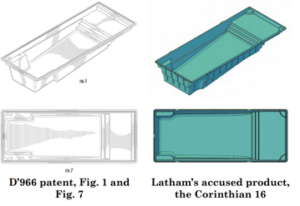
North Star is a noteworthy case where the Federal Circuit affirmed summary judgment, concluding that the accused swimming pool design was “plainly dissimilar” from the patented design. The Court concluded that “both designs relate to rectangular swimming pools with steps, benches, and tanning ledges, but North Star’s patent only protects the ornamental aspect—here, the angular shape—of those ubiquitous features.” In its infringement analysis, the Court focused only on the ornamental aspects, disregarding elements considered ubiquitous to swimming pools.
North Star has since filed a petition for a panel rehearing, arguing that the “Court provided no guidance on when the ‘sufficiently distinct’ test applies. To this day, this standalone test lacks any guardrails or objective criteria.”
Shown below is North Star’s patented design and Latham’s accused product. Do you agree with the Court? Was Latham’s design sufficiently distinct?
Have additional questions? Please reach out to the Tucker Ellis team.